
Ex Jameson, pedigreed to 1905
Lot 94
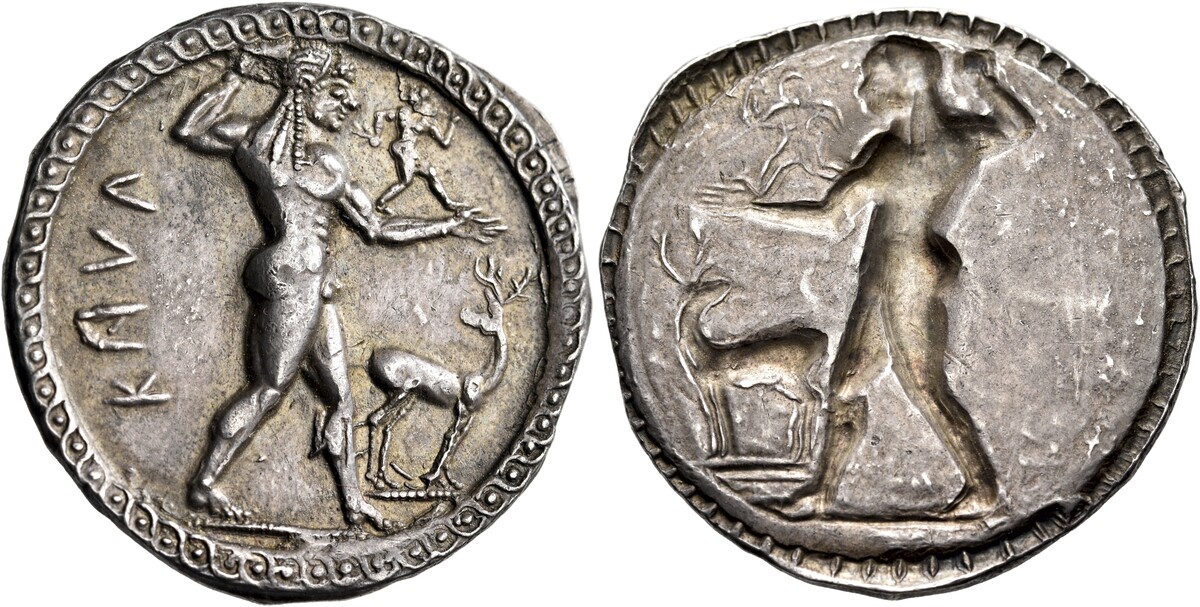
BRUTTIUM. Kaulonia. Circa 525-500 BC. Nomos (Silver, 30 mm, 8.00 g, 12 h). ΚΑVΛ Apollo, nude, striding right, brandishing laurel branch in his upraised right hand and, on his outstretched left arm, small figure of a daimon running to right, holding a branch in each of his hands and with his head turned back to look at Apollo; to right, stag standing right, head turned back to left; all within cable border. Rev. As the obverse, but incuse, except for the daimon, branches and stag's antlers, which are in relief, and with no legend. HN III, 2035. Noe, Caulonia, Group A, 8g corr. (this coin, but dies of 9). SNG ANS 144-5 (same obverse die). SNG Lockett 579 (same dies). Attractive old collection toning. Light marks, otherwise, extremely fine.
From a Swiss collection, ex Platt, 19 May 1921, 26, and from the duplicates of R. Jameson, Rollin & Feuardent, 20 June 1906, 323, and from the collection of H. Smith, Sotheby's, 5 June 1905, 43.
All social strata in the cities of Magna Graecia relied on various forms of soothsaying, but oracles offered a far more prestigious way to glimpse the future. The most celebrated of these were often associated with Apollo. He was also the only Olympian god who kept his original name after being adopted into the Roman religion, which highlights his unique importance. His cult was celebrated differently from place to place. One local manifestation of Apollo-worship, still not fully understood by us, is that of Kaulonia, a Greek colony on the coast of what is nowadays the Italian region of Calabria. Its early coins were produced in the incuse technique, which was specific to several mints in Magna Graecia. The reasons for choosing this difficult technique are unclear, sometimes practical reasons are given, sometimes stylistic predilections and even links to the intellectual world of the Pythagoreans are suggested as a possibility.
While scholars agree that the male figure on the obverse represents Apollo and that the stag accompanying him refers to his sister Artemis, the small running figure on Apollo’s outstretched arm remains an enigma! It most likely represents a daimon—a divinity of a lower order who serves as a messenger of the gods. Given the figure's occasionally winged feet, it may be that this daimon should be seen as a wind god such as Zephyrus. However, how this daimon was integrated into the local cult at Caulonia remains a riddle to archaeologists and historians alike.
Current Status
Online bidding closes: 22 Nov 2026, 09:00:00 CET Current Date & Time: 16 Oct 2026, 23:41:43 CEST Remaining Time: Loading... Current Bid:No Bids Bid Increment: 1000 CHF Minimum Bid must be: 12000 CHF Your Maximum Bid in CHF:Pre-Bidding closes on 22 November 2026 at 9:00 CET. Live bidding starts at 14:00 CET and is EXCLUSIVELY available on biddr. Separate registration is required.

